In Java, the List interface is an ordered collection that allows us to store and access elements sequentially. It extends the Collection interface.
Classes that Implement List
Since List is an interface, we cannot create objects from it.
In order to use functionalities of the List interface, we can use these classes:
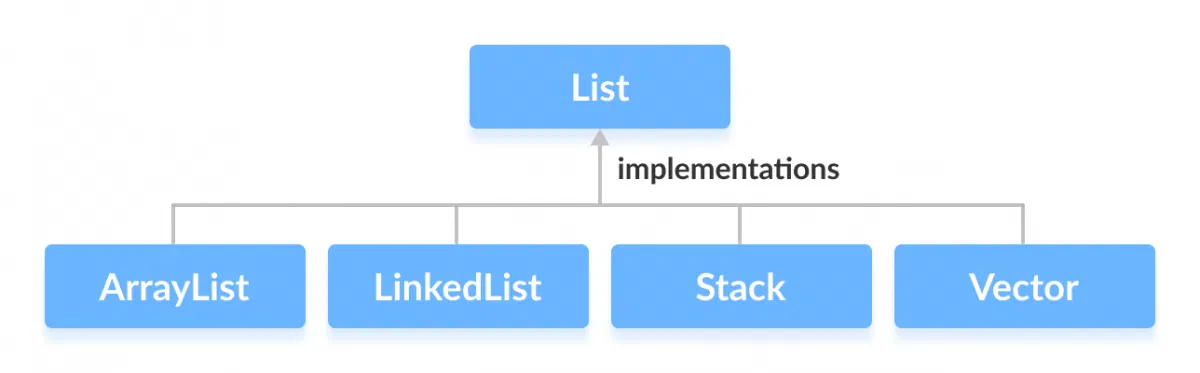
These classes are defined in the Collections framework and implement the List interface.
How to use List?
In Java, we must import java.util.List package in order to use List.
// ArrayList implementation of List
List<String> list1 = new ArrayList<>();

// LinkedList implementation of List
List<String> list2 = new LinkedList<>();
Here, we have created objects list1 and list2 of classes ArrayList and LinkedList. These objects can use the functionalities of the List interface.
Methods of List
The List interface includes all the methods of the Collection interface. Its because Collection is a super interface of List.
Some of the commonly used methods of the Collection interface that's also available in the List interface are:
add()- adds an element to a listaddAll()- adds all elements of one list to anotherget()- helps to randomly access elements from listsiterator()- returns iterator object that can be used to sequentially access elements of listsset()- changes elements of listsremove()- removes an element from the listremoveAll()- removes all the elements from the listclear()- removes all the elements from the list (more efficient thanremoveAll())size()- returns the length of liststoArray()- converts a list into an arraycontains()- returnstrueif a list contains specified element
Implementation of the List Interface
1. Implementing the ArrayList Class
import java.util.List;
import java.util.ArrayList;

class Main {

    public static void main(String[] args) {
        // Creating list using the ArrayList class
        List<Integer> numbers = new ArrayList<>();

        // Add elements to the list
        numbers.add(1);
        numbers.add(2);
        numbers.add(3);
        System.out.println("List: " + numbers);

        // Access element from the list
        int number = numbers.get(2);
        System.out.println("Accessed Element: " + number);

        // Remove element from the list
        int removedNumber = numbers.remove(1);
        System.out.println("Removed Element: " + removedNumber);
    }
}
Output
List: [1, 2, 3]
Accessed Element: 3
Removed Element: 2
To learn more about ArrayList, visit Java ArrayList.
2. Implementing the LinkedList Class
import java.util.List;
import java.util.LinkedList;

class Main {

    public static void main(String[] args) {
        // Creating list using the LinkedList class
        List<Integer> numbers = new LinkedList<>();

        // Add elements to the list
        numbers.add(1);
        numbers.add(2);
        numbers.add(3);
        System.out.println("List: " + numbers);

        // Access element from the list
        int number = numbers.get(2);
        System.out.println("Accessed Element: " + number);

        // Using the indexOf() method
        int index = numbers.indexOf(2);
        System.out.println("Position of 3 is " + index);

        // Remove element from the list
        int removedNumber = numbers.remove(1);
        System.out.println("Removed Element: " + removedNumber);
    }
}
Output
List: [1, 2, 3]
Accessed Element: 3
Position of 3 is 1
Removed Element: 2
To learn more about LinkedList, visit Java LinkedList.
Java List vs. Set
Both the List interface and the Set interface inherits the Collection interface. However, there exists some difference between them.
- Lists can include duplicate elements. However, sets cannot have duplicate elements.
- Elements in lists are stored in some order. However, elements in sets are stored in groups like sets in mathematics.
Now that we know what List is, we will see its implementations in ArrayList and LinkedList classes in detail in the next tutorials.